NFL Weekly Game Predictions: Matchup Odds and Betting Picks
 Available in US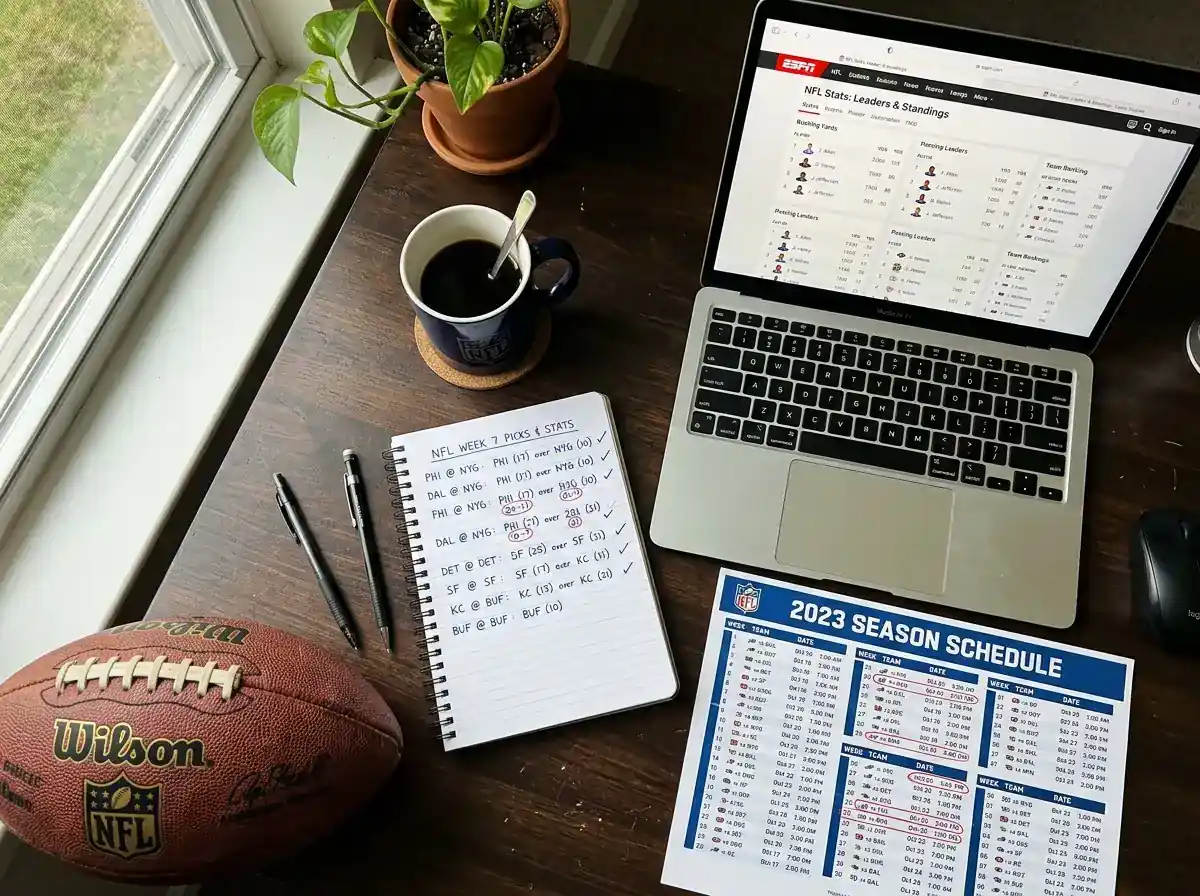
Sports betting accounts for 52% of all online gambling revenue globally, and the NFL’s weekly cycle is one of the most structured betting environments in sport. Every week, the same process: lines open Monday, information flows in through the week, and the market settles by Sunday kick-off. That rhythm creates an ideal framework for systematic analysis – the kind that turns casual predictions into informed wagers.
Former NFL executive Mike Lombardi called American football “chess on grass,” and that complexity is precisely why a structured prediction framework matters. There are too many variables to hold in your head simultaneously. A checklist-driven approach ensures you don’t skip the factor that turns out to decide the game.
NFL Weekly Matchup Analysis and Betting Framework
I’ve refined my weekly analysis process over twelve years of NFL betting, and the version I use today takes roughly ninety minutes per game. That sounds like a lot, but I only analyse four to six games per week – the ones where my initial screen suggests potential value. Not every game deserves your time.
Step one: check the spread and total. Before doing any analysis, note the opening line. Your job is to determine whether the market has this right or wrong. If your analysis lands in the same place as the line, there’s no bet – move on to the next game. Write down your initial reaction to the number before diving into the data, then compare it to your conclusion after analysis. This discipline prevents you from working backwards from a desired conclusion.
Step two: pull injury reports. The NFL requires teams to submit injury designations on Wednesday, Thursday, and Friday. By Friday afternoon, you’ll know who’s “out” (not playing), “doubtful” (unlikely to play), “questionable” (roughly 50/50), and “probable” (likely to play). The impact of an injury depends entirely on the player’s role – a backup right guard being out barely matters, while a starting quarterback being questionable changes everything. Evaluate injuries by positional importance: quarterback, left tackle, top cornerback, and primary edge rusher are the positions where absence most significantly affects the spread.
Step three: analyse the matchup advantages. This is where the ninety minutes go. Which team’s offensive strengths align against the opponent’s defensive weaknesses? A team with an elite passing attack facing a defence that ranks bottom five in yards per pass attempt has a structural advantage the spread may not fully reflect. Reverse the analysis for the other side. Sometimes both teams have clear matchup edges in different areas – that often points toward a totals bet rather than a spread bet.
Step four: check the weather. For outdoor games, pull the forecast for the stadium location at kick-off time. Wind above 15mph affects passing and kicking. Temperatures below freezing affect ball handling. Rain on a grass surface affects footing. Indoor games eliminate this step entirely. I maintain a simple threshold: if wind exceeds 15mph, I adjust my totals analysis downward by two to three points from where I’d otherwise set it.
Step five: evaluate the schedule spot. Is either team on a short week? Coming off a bye? Playing a divisional rival after facing an emotional non-conference game? Schedule context affects effort and preparation quality. A team that just played a Monday Night game and now has to travel for a Sunday 18:00 GMT kick-off has had three days less preparation than normal. That context is real and measurable in historical ATS data.
Injury and Weather Factors in Detail
The official NFL injury report is your primary data source, but it requires interpretation rather than face-value reading.
A “questionable” designation is genuinely uncertain – roughly half the time the player plays, half the time they sit. What matters is the trajectory. A player who was “limited” in Wednesday practice, “limited” Thursday, and “full” Friday but listed as “questionable” is almost certainly playing. A player who missed all three practices and is listed “questionable” is much more likely to sit. The Friday practice status is the strongest signal within the official report.
Unofficial sources supplement the injury report. Beat reporters for each team publish observations from the visible portions of practice – who’s participating, who’s in a non-contact jersey, who’s absent. These reports often appear before the official injury designations and give you a head start on evaluating the likely impact. Following two or three reliable beat reporters per team you frequently bet on is a research investment that pays dividends all season.
Weather analysis should be stadium-specific, not city-wide. Wind patterns at open-air stadiums like Buffalo or Chicago can differ significantly from the forecast for the broader metro area due to stadium orientation and surrounding structures. Historical wind data for specific NFL stadiums is available through weather archives and can help calibrate your thresholds for when weather materially affects scoring.
Turning Analysis into Betting Decisions
Live in-play betting now accounts for 53.4% of all wagering activity globally – more than pre-match for the first time. But the analytical framework above is designed for pre-game decision-making, where the edge tends to be more durable and the emotional pressure is lower.
After completing your analysis, you’ll have an opinion on where the spread and total “should” be. If your number differs from the market by 1.5 points or more on the spread, or 2.5 points or more on the total, you have a potential bet. Differences smaller than these thresholds are within the margin of error of any analytical approach and don’t represent genuine value.
Record-keeping transforms this framework from a weekly exercise into a long-term edge. Log your predicted spread and total alongside the actual market line for every game you analyse, then track how your predictions perform against the closing line over the season. If your predictions are systematically more accurate than the market on specific game types (divisional matchups, weather games, teams coming off a bye), you’ve identified a genuine analytical advantage to exploit. If they’re not, your framework needs refinement, and the record tells you exactly where.
One discipline I enforce strictly: never bet a game I haven’t fully analysed through all five steps. The temptation to add a last-minute bet on a game you only glanced at – because a friend mentioned it, or the odds look attractive, or you want more action on a Sunday – is the single biggest leak in most bettors’ processes. The framework exists to filter, and filtering means saying no more often than yes. For the analytical tools that feed into step three of this framework, the guide to NFL advanced metrics covers EPA, DVOA, and where to find free data.
How early should I start my NFL weekly analysis?
Monday evening or Tuesday morning is ideal for UK bettors, as opening lines appear on Monday morning GMT. Starting early gives you access to the widest prices before sharp money moves the lines. Complete your injury and weather analysis by Friday, then make final decisions once Friday injury designations are published.
What is a ‘schedule spot’ and why does it matter?
A schedule spot refers to the context of a team’s schedule around a particular game – whether they are on a short week, coming off a bye, playing before or after a divisional rival, or sandwiched between two emotionally significant matchups. Teams in a ‘look-ahead’ spot (a tough game the following week) historically underperform relative to the spread, while teams off a bye tend to outperform.
Published by the American Football bet team.