
NFL Betting Record Tracking: ROI Metrics and Yield Analysis
 Available in US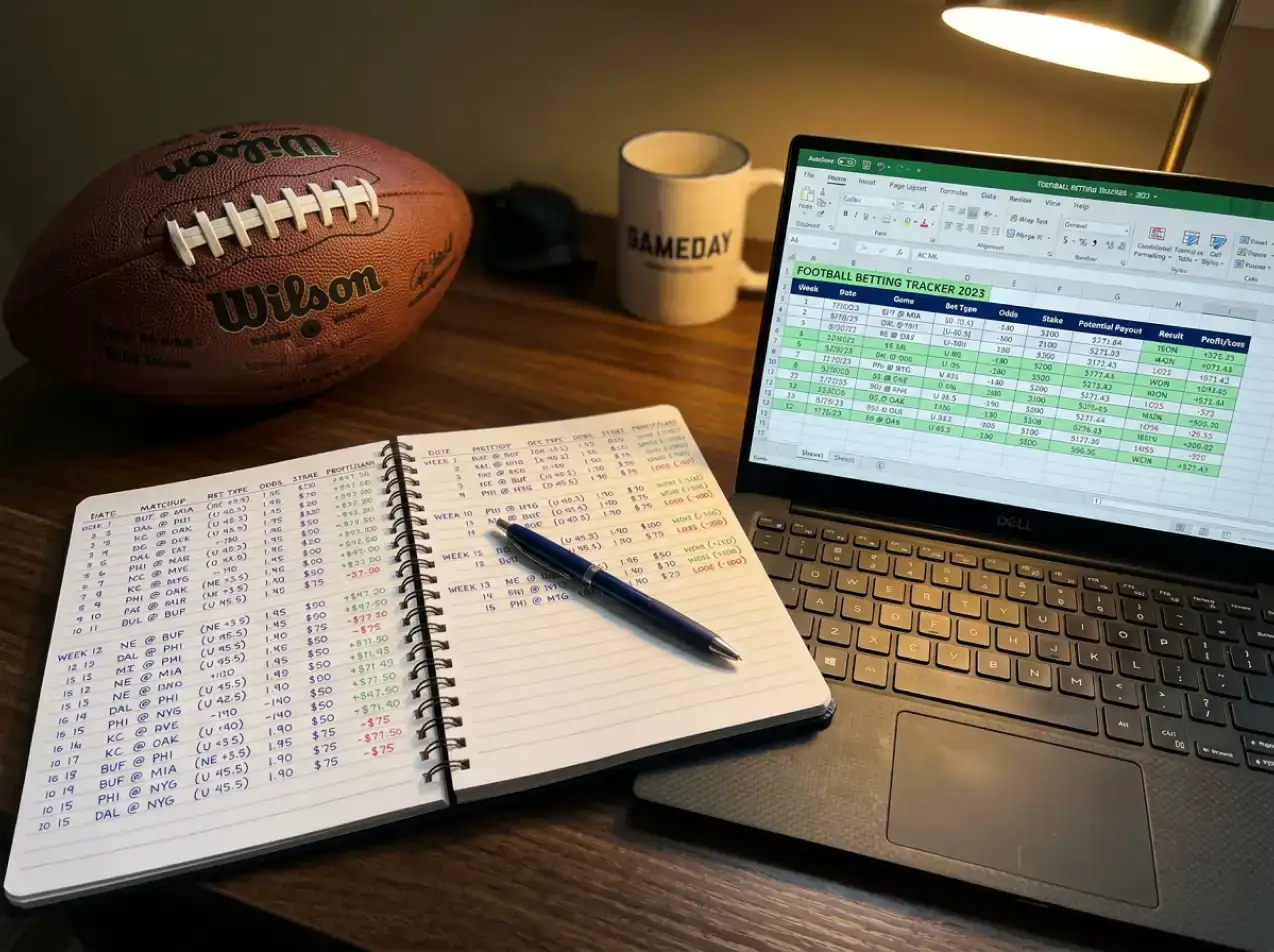
About 8% of UK adults actively bet on sport, and I’d wager that fewer than 10% of those bettors track their results with any rigour. The rest rely on memory – which is selective, self-serving, and utterly unreliable as an analytical tool. You remember the five-leg acca that hit in Week 7. You forget the twelve that didn’t. Memory tells you you’re doing well; records tell you the truth.
I started tracking every NFL bet in a spreadsheet during my second season of serious wagering. Within three months, the data showed me something uncomfortable: my spread bets were profitable but my prop bets were haemorrhaging money. Without the record, I’d have continued doing both at equal volume, confident I was a sharp bettor because the spread wins felt good. The props were silently eating those gains. That spreadsheet has saved me thousands of pounds over the years – not by finding winners, but by identifying losers.
Essential Metrics for NFL Betting Record Tracking
The minimum viable record captures seven data points per bet. Anything fewer and you can’t draw meaningful conclusions. Anything more and the tracking becomes burdensome enough that you’ll abandon it by Week 6.
Date: when you placed the bet, not when it settled. This lets you analyse whether bets placed early in the week (when lines are softer) outperform bets placed on gameday.
Game: the two teams playing. Over time, you’ll discover whether you perform better or worse when betting certain teams – not because the teams are inherently more or less predictable, but because your analysis may have blind spots that correlate with specific matchup types.
Market: spread, moneyline, total, player prop, futures, accumulator. This is the most important categorisation for long-term analysis, because your edge almost certainly varies by market type.
Odds: the exact odds at which you placed the bet, in whichever format you use (fractional, decimal). If you also record the closing line odds, you can calculate closing line value – the gold standard metric for evaluating whether you’re consistently getting better prices than the market’s final assessment.
Stake: the amount wagered in pounds. Essential for calculating actual profit and loss rather than just win-loss percentages.
Result: win, loss, push, or void. Plus the actual score or outcome for context.
Profit/Loss: the net result in pounds. A ten-pound bet at 10/11 that wins produces a profit of nine pounds nine pence. A ten-pound bet that loses produces a loss of ten pounds. Tracking this in currency rather than just units reveals the actual financial impact of your betting activity.
Closing line value (CLV) deserves its own mention. Record the odds at which you placed the bet and the odds at kick-off. If you consistently bet at prices that are better than the closing line, you’re beating the market’s efficiency – the single strongest predictor of long-term profitability. CLV is more predictive than raw win rate, because a bettor with a 52% win rate who consistently gets better prices will outperform a bettor with a 54% win rate who consistently takes worse prices.
Analysing Your Records for Patterns
The UK gambling market is projected to grow by $4.24 billion between 2026 and 2030. A growing market means more opportunities – but only for bettors who know where their own opportunities actually lie.
The first analysis to run: ROI by market type. Calculate your total profit or loss on spreads, totals, moneylines, props, accumulators, and futures separately. The results will almost certainly show that you’re profitable in some markets and unprofitable in others. This is normal – very few bettors have an edge across every market. The actionable insight is to increase volume on your profitable markets and reduce or eliminate volume on unprofitable ones.
ROI by week of season reveals seasonal patterns in your performance. Some bettors perform better early in the season when the market is adjusting to new rosters. Others find their edge in the second half when they’ve accumulated enough data to build reliable models. If your records show consistently negative ROI in Weeks 1-4 and consistently positive ROI from Week 8 onward, the optimal strategy is obvious: reduce your early-season volume and ramp up later.
ROI by bookmaker shows which operators are giving you the best prices. If 60% of your winning bets were placed at one bookmaker and only 15% at another, the first operator is either offering better odds or deeper markets in areas where you have an edge. Shift more of your volume accordingly.
Sample size is the caveat that underpins all this analysis. Fifty bets on NFL spreads is not a meaningful sample. Two hundred starts to be useful. Five hundred provides reliable signal. Be cautious about drawing strong conclusions from thin data, and always ask whether a pattern you’ve spotted would hold up if the sample were doubled. Statistical significance isn’t a luxury for serious bettors – it’s a necessity.
Tools and Templates for Tracking
You don’t need expensive software. A Google Sheets spreadsheet with the seven columns described above is sufficient for 90% of bettors. The virtue of a spreadsheet is its flexibility – you can add calculated columns for ROI, running P/L, CLV, and any other derived metric without switching tools.
Formulas worth setting up from the start: cumulative P/L (running total of all profit and loss), ROI percentage (total profit divided by total stakes, times 100), and CLV tracking (your odds minus closing odds, expressed as implied probability difference). These three calculations, updating automatically as you add new rows, give you a live dashboard of your betting performance without any manual work beyond entering each bet’s basic data.
Dedicated bet tracking apps exist and can be useful if you prefer mobile-first tracking. The advantage of an app is speed – logging a bet immediately after placing it takes ten seconds instead of waiting until you’re at a computer. The disadvantage is less analytical flexibility compared to a spreadsheet. Some bettors use both: the app for real-time logging, then export to a spreadsheet for end-of-week analysis.
Whatever tool you choose, the rule is the same: log every bet, without exception. Cherry-picking which bets to record – consciously or unconsciously – destroys the integrity of the dataset. The embarrassing loss that you’d rather forget is exactly the data point your analysis needs most. Honest record-keeping is the prerequisite for every improvement described in the common mistakes guide – you can’t fix errors you haven’t measured.
How many bets do I need to track before judging my NFL record?
A minimum of 200 bets within a specific market type (spreads, totals, props) provides a useful initial sample. Fewer than 100 bets makes it nearly impossible to distinguish skill from variance. For meaningful statistical confidence, aim for 500 or more bets before drawing firm conclusions about your long-term edge in any market.
What is closing line value and why does it matter?
Closing line value (CLV) measures whether the odds you bet at were better than the final odds at kick-off. If you consistently get better prices than the closing line, you are systematically beating the market’s most efficient assessment of the game. Research shows CLV is the strongest predictor of long-term betting profitability – more so than raw win rate.
Written by the editors at American Football bet.