NFL Live Betting Odds 2026: Real-Time In-Play Wagering Markets
 Available in US
Something shifted in 2026 that every NFL bettor should know about: live in-play wagering overtook pre-match betting for the first time, accounting for 53.4% of all global betting activity. That crossover isn’t a blip. It’s the market telling us where the future of sports betting lives — in the seconds between plays, in the adjustments at half-time, in the chaos of a fourth-quarter comeback.
For UK punters, live NFL betting presents a specific opportunity and a specific challenge. The opportunity: you’re watching the game unfold in real time and can spot situations where the live odds haven’t caught up to what’s happening on the field. The challenge: NFL games kick off at 6pm, 9pm, and 1am UK time, which means your sharpest live betting window often coincides with your tiredness. The temptation to make impulsive bets after a few hours on the sofa is real, and it’s the primary reason live betting costs more punters money than it earns.
I’ve been live-betting NFL games for eight seasons now, and my approach has evolved from “bet whatever looks interesting during the game” to a structured, quarter-by-quarter framework that treats each phase of the game differently. This guide lays out that framework — the markets available, the timing, the discipline rules that keep the process profitable rather than recreational. Every concept is grounded in the UK context: our time zones, our bookmaker platforms, and the particular challenges of live betting a sport that peaks while most of Britain is heading for bed.
Since in-play odds shift rapidly between snaps, using a reliable NFL mobile betting app ensures you never miss a valuable price.
NFL In-Play Betting Markets at UK Sportsbooks
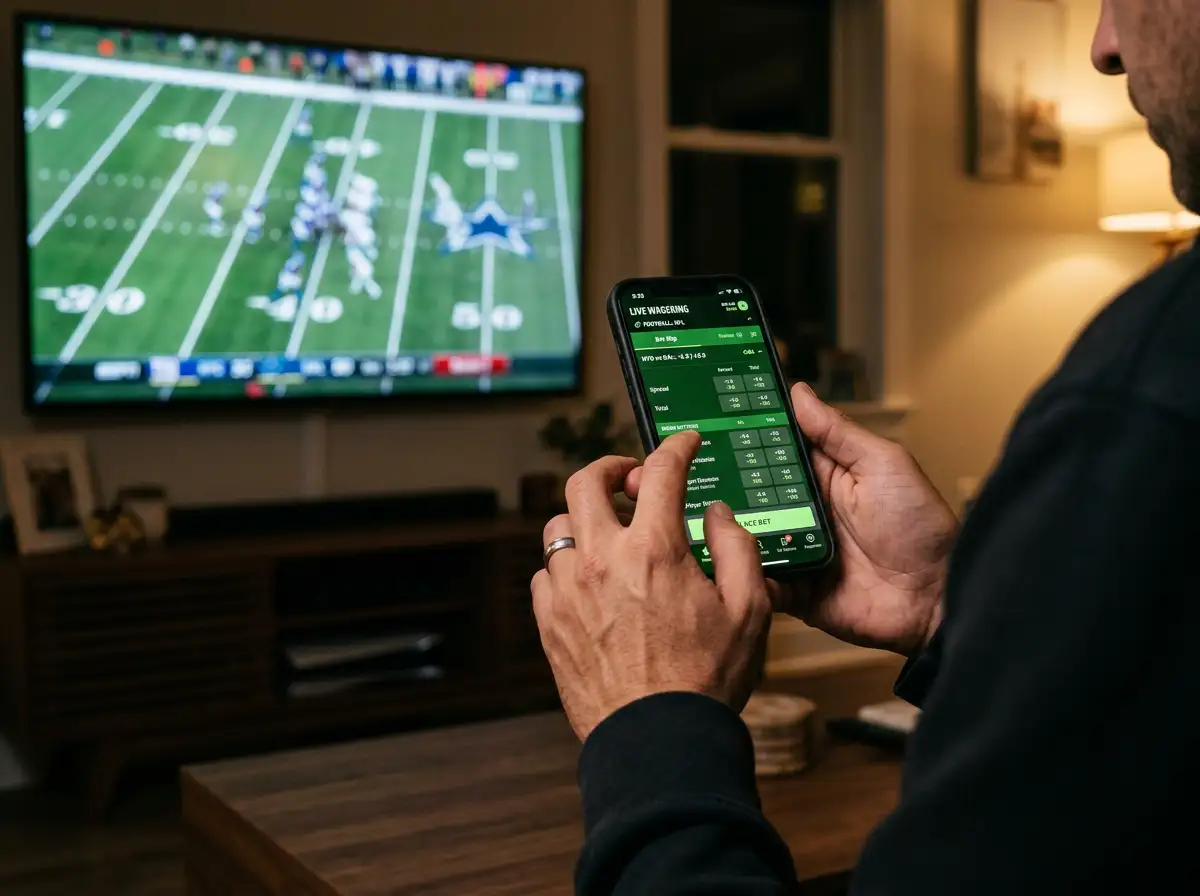
Mobile devices generate 80% of sports bets globally, and live NFL betting is overwhelmingly a mobile experience. You’re on the sofa, phone in hand, watching the game — that’s the setup. What you see on your screen depends heavily on which UK bookmaker you’re using, because the depth of live NFL markets varies dramatically between platforms.
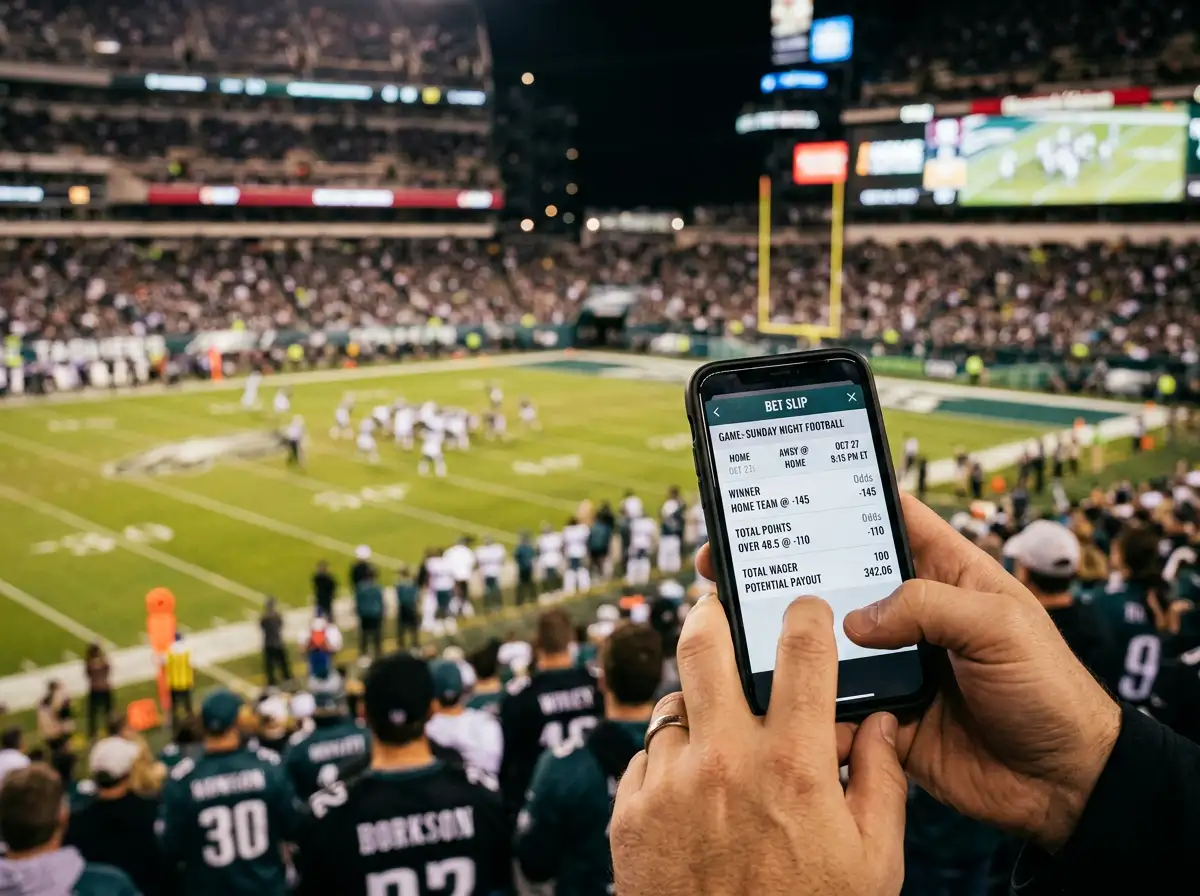
The core live markets available at virtually every major UK bookmaker are the live spread (adjusted from the pre-match line based on the current score and game situation), the live total (over/under on the combined score from that point forward), and the live moneyline (outright winner). These three are always there, updating every few seconds as the game progresses.
Beyond those basics, the market depth diverges. The better platforms offer next scoring play (will the next score be a touchdown, field goal, or safety?), drive result (will the current offensive drive end in a score, a punt, a turnover?), quarter winner (which team will outscore the other in the current quarter?), and alternative live spreads (letting you buy a bigger or smaller number than the main live line). Some bookmakers also offer live player props — will this quarterback throw an interception on this drive, will this running back score the next touchdown — though these tend to be limited to marquee games with the highest viewership.
The “next scoring play” market is my personal favourite for live betting. It’s a relatively simple proposition — you’re typically choosing between touchdown and field goal — and it’s one where watching the game gives you a genuine information edge. If a team has driven to the opponent’s 5-yard line with a strong running game, a touchdown is far more likely than the live odds might suggest, particularly if the odds haven’t adjusted for the specific yardline yet. Conversely, if a team stalls at the 35-yard line and the kicker is warming up, a field goal is practically assured, and the market sometimes lags behind that visual information by a few seconds.
One category of live market I’d approach with extreme caution: anything involving very small sample sizes within a game. “Will there be a score in the next two minutes?” or “Will the next play be a pass or a run?” — these are essentially coin-flip propositions with heavy overrounds, and the bookmaker’s edge is much larger than on main-line live markets. The vig on micro-markets can exceed 15%, making them extremely difficult to beat even with good in-game reads.
The player prop guide covers the research methods for prop betting in more detail, including how snap counts and target shares affect pre-match prop pricing — many of those same principles apply to live player props when they’re available.
Quarter-by-Quarter Live Betting Approach
The worst live-betting habit I ever had was treating an NFL game as one continuous three-hour betting opportunity. It isn’t. Each quarter has a distinct character, and my results improved markedly once I started treating them as four separate analytical windows.
First Quarter: Observe, Don’t React
The first quarter of an NFL game is information-gathering time. Both teams are executing their opening scripts — the plays they’ve specifically prepared for the first fifteen or twenty snaps. Those plays often look nothing like the rest of the game plan. A team might come out throwing aggressively to set up the run later, or vice versa. The live spread after a first-quarter touchdown by the underdog often overreacts, shifting several points in the trailing team’s favour. I’ve learned to resist the temptation to bet in the first quarter almost entirely unless something genuinely unexpected has happened — a starting quarterback injury, a defensive scheme that’s clearly mismatched, or a weather change that the pre-match market didn’t account for.
Second Quarter: The Half-Time Line Emerges
By midway through the second quarter, you’ve seen 25-30 plays from each offence. That’s enough data to start forming opinions about which team looks sharper, which game plan is working, and whether the pre-match spread was accurate. The half-time line — the spread for the second half only — is one of the most valuable live markets in NFL betting. It resets the handicap based on how the first half played out, and because it’s priced rapidly with less modelling time than a pre-match line, it’s more prone to mispricings. I make more live bets in the five minutes surrounding half-time than in any other window of the game.
The key to half-time line betting is understanding regression. If a team dominated the first half but only has a one-score lead because of red zone failures, the second-half line often overweights the first-half dominance rather than pricing in the regression that typically follows. Red zone efficiency is notoriously volatile — a team that went 1-for-4 in the first-half red zone isn’t suddenly bad at scoring touchdowns. They ran into bad luck or tight coverage on a handful of plays. The second-half line rarely prices this regression accurately, which means the trailing team’s second-half spread often offers value.
Conversely, if a team is trailing because they’ve been comprehensively outplayed — negative EPA on every drive, defensive breakdowns at every level, no signs of schematic adjustment — the second-half line won’t offer value on the trailing side. The first half told the truth. Learning to distinguish between “bad luck” and “bad team” at half-time is one of the most profitable skills in live NFL betting, and it comes only from watching games attentively rather than relying on the scoresheet alone.
Third Quarter: Adjustments and Overreactions
Coaching adjustments define the third quarter. The better coaching staff has had fifteen minutes to diagnose what went wrong and change the plan. If a defence was getting shredded by play-action passes in the first half, expect them to adjust their personnel groupings and coverage schemes after the break. The market often underweights these adjustments because the algorithms pricing live odds rely heavily on first-half performance data. If you know — from studying coaching tendencies throughout the season — that a particular defensive coordinator is elite at half-time adjustments, the live under on the total entering the third quarter can offer genuine value.
Fourth Quarter: Garbage Time and Backdoor Covers
The fourth quarter is where live betting gets dangerous for the undisciplined. Trailing teams abandon their game plans and throw downfield constantly. Some of those passes connect, producing scores that tighten the final margin without ever reflecting a genuine competitive shift. This is “garbage time” — scoring that occurs when the game’s outcome is already decided but the scoreboard doesn’t fully reflect it yet. For spread bettors, garbage-time touchdowns create “backdoor covers” where the losing team covers the spread despite never being in serious contention. The live spread often tightens during garbage time as the scores get closer, offering what looks like value on the leading team. Be cautious. If the trailing team is scoring freely against a prevent defence, the leading team’s adjusted odds may be artificially attractive. The leading team isn’t suddenly vulnerable — they’ve just stopped trying to maximise their margin because the game is won.
For UK punters, the time zone dimension adds another layer. The Sunday early window kicks off at 6pm GMT, which means the fourth quarter falls around 9-9:30pm — prime fatigue territory if you’ve been watching since kick-off. The late window’s fourth quarters don’t arrive until after midnight. I’ve made a strict rule: no live bets in the fourth quarter of any game that kicks off after 9pm UK time. The combination of tiredness and garbage-time distortions makes it a losing environment even for sharp bettors.
Discover more real-time strategies and tips on the top UK NFL betting site to maximize your in-game profits.
How Live NFL Odds Move and When to Strike
Bill Miller of the American Gaming Association noted that legal sports betting “enhances the fun and friendly competition that make NFL games and traditions even more special.” He’s describing the recreational side. For analytical bettors, what makes live odds special is the speed at which they move — and the windows of inefficiency that speed creates.
Live NFL odds are set by algorithms, not humans. Bookmakers use automated pricing models that ingest the current score, time remaining, down and distance, field position, and team strength ratings to generate real-time odds. These models are good — but they’re not perfect. They lag behind sudden, high-impact events by a few seconds, and those seconds are where experienced live bettors find their edge.
The global online gambling market is valued at $101.45 billion in 2026, and the live betting segment is the fastest-growing portion of it. The technology driving live odds is improving constantly, which means the windows of inefficiency are shrinking. Five years ago, you might have had fifteen or twenty seconds after a turnover before the live spread adjusted. Today, it’s more like three to five seconds. That’s still enough time to act if you’re prepared, but it demands a different kind of readiness than pre-match betting. You need to know what you want to bet before the event happens — have a plan for “if there’s a turnover, I’ll take the live spread on the team that just gained possession” — rather than reacting after the fact.
Turnovers are the single biggest live-odds dislocators. An interception or fumble recovery changes field position, momentum, and scoring probability simultaneously. The live spread adjusts for the field position instantly but often underweights the momentum shift — teams that force turnovers tend to score on the ensuing drive at a higher rate than the raw field position would suggest, because the defensive energy carries over. I look for live spread opportunities immediately after turnovers, particularly when the turnover occurs in the opponent’s territory.
Injuries mid-game create slower, longer-lasting odds adjustments. If a starting quarterback leaves with an injury, the live spread might shift by three to five points within a few minutes. But the initial shift often undershoots the true impact, especially if the backup quarterback hasn’t played meaningful snaps in years. The market prices in an “average backup” discount, but backup quarterbacks are not average — some are serviceable, some are genuinely terrible, and the live odds don’t always distinguish between the two quickly enough.
Latency is a real factor for UK punters. The broadcast feed you’re watching on Sky Sports or Game Pass is delayed by anywhere from five to thirty seconds compared to the real-time feed that in-stadium bettors and US-based sharps have access to. That delay means you’ll never be the first to react to an on-field event. What you can do is anticipate. If you see a team driving efficiently and approaching the red zone, prepare your bet before the scoring play happens so you can execute quickly rather than scrambling after the fact.
Discipline and Bankroll Rules for Live NFL Betting
I need to be direct about something: live betting is the single most dangerous format for your bankroll. The UK Gambling Commission reports a problem gambling rate of 2.7% among adults, and while I don’t have sport-specific breakdowns, the characteristics of live betting — instant gratification, continuous availability, emotional arousal from watching the game — map almost perfectly onto the behavioural triggers associated with problem gambling. Acknowledging this isn’t weakness. It’s strategic awareness.
My live betting rules are non-negotiable, and I’d encourage you to develop your own equivalent set before placing a single in-play wager:
First, pre-set a session bankroll. Before any game, I decide the maximum amount I’m willing to risk on live bets for that session. It’s typically 3-5 units — separate from my pre-match bets on the same game. When that session bankroll is gone, I stop. No exceptions. No “one more bet to get back.” The session bankroll creates a hard ceiling that prevents a bad stretch from spiralling.
Second, no chasing. If my first live bet loses, the instinct is to immediately place another to recover the loss. That instinct is the enemy. I enforce a mandatory five-minute cooling-off period between live bets, regardless of whether the previous one won or lost. Five minutes is long enough to break the emotional cycle and short enough that it doesn’t lock me out of genuine opportunities.
Third, limit the number of games I live-bet in any single day. The NFL Sunday slate features thirteen or fourteen simultaneous games. The temptation to scatter live bets across multiple games — a spread here, a total there, a next-scoring-play prop on a third — fragments your attention and degrades the quality of every decision. I live-bet a maximum of two games per session. Those are the two I’ve researched most thoroughly pre-match, the two I’m watching most closely, and the two where I trust my in-game reads. Everything else gets a pre-match bet or no bet at all.
Fourth, track live bets separately from pre-match bets in your records. This is vital for honest self-assessment. Many punters — myself included, in my early years — discover that their pre-match record is profitable and their live record is deeply negative. The aggregate looks okay, masking the fact that live betting is actively destroying the edge built by pre-match analysis. If your live betting record is negative after 100 tracked bets, consider whether the format is adding value to your overall approach or subtracting it.
The tools built into UK bookmaker apps — deposit limits, session time reminders, reality checks — are there for a reason, and I use them. Setting a session time reminder at 90 minutes ensures I get a prompt to pause and assess whether I’m still making clear-headed decisions or operating on adrenaline and habit. These aren’t training wheels. They’re structural safeguards that every professional-minded bettor should treat as part of their standard setup.
One last thing on discipline: review your live bets the next morning, not in the afterglow of the game. I keep a brief note for each live bet — one sentence on why I placed it. “Took the live under after the third-quarter wind picked up” or “Backed the live spread on the trailing team after a first-half dominated by red zone failures.” Reading those notes the next day, without the emotional charge of the game, reveals patterns you can’t see in the moment. You’ll quickly learn which types of in-game situations you read well and which ones consistently fool you. That feedback loop is the difference between live betting as a skill and live betting as entertainment.
NFL Live Betting FAQ
How does live/in-play NFL betting work on UK sites?
Live NFL betting lets you place wagers during the game with odds that update in real time based on the score, time remaining, and game situation. You select a live market (spread, total, next scoring play, etc.), choose your position, and confirm the bet. The odds you accept at the moment of confirmation are locked in — any subsequent movement doesn’t affect your bet. Most UK bookmakers offer live betting through their mobile apps with one-tap bet placement.
Can I cash out NFL live bets early?
Most major UK bookmakers offer cash-out on NFL live bets, allowing you to settle your bet at a price determined by the current live odds before the game ends. Cash-out prices are typically less favourable than letting the bet run because the bookmaker builds in a margin. Use cash-out selectively — it makes sense when new information (like a key injury) has fundamentally changed the game’s trajectory and you want to lock in a partial profit or limit a potential loss.
Which UK bookmaker has the best NFL live betting coverage?
Market depth varies significantly between platforms and changes season to season, so I recommend opening the live NFL section at three or four bookmakers during a game week and comparing what’s available. Look for the number of live markets offered (some post 30+, others fewer than 10), the speed of odds updates, the availability of alternate live spreads, and whether live player props are included. The best approach is to have accounts at multiple sites and use whichever offers the deepest coverage for the specific game you’re watching.
Published by the American Football bet team.