NFL Betting Strategy: Bankroll Management and Data Models
 Available in US
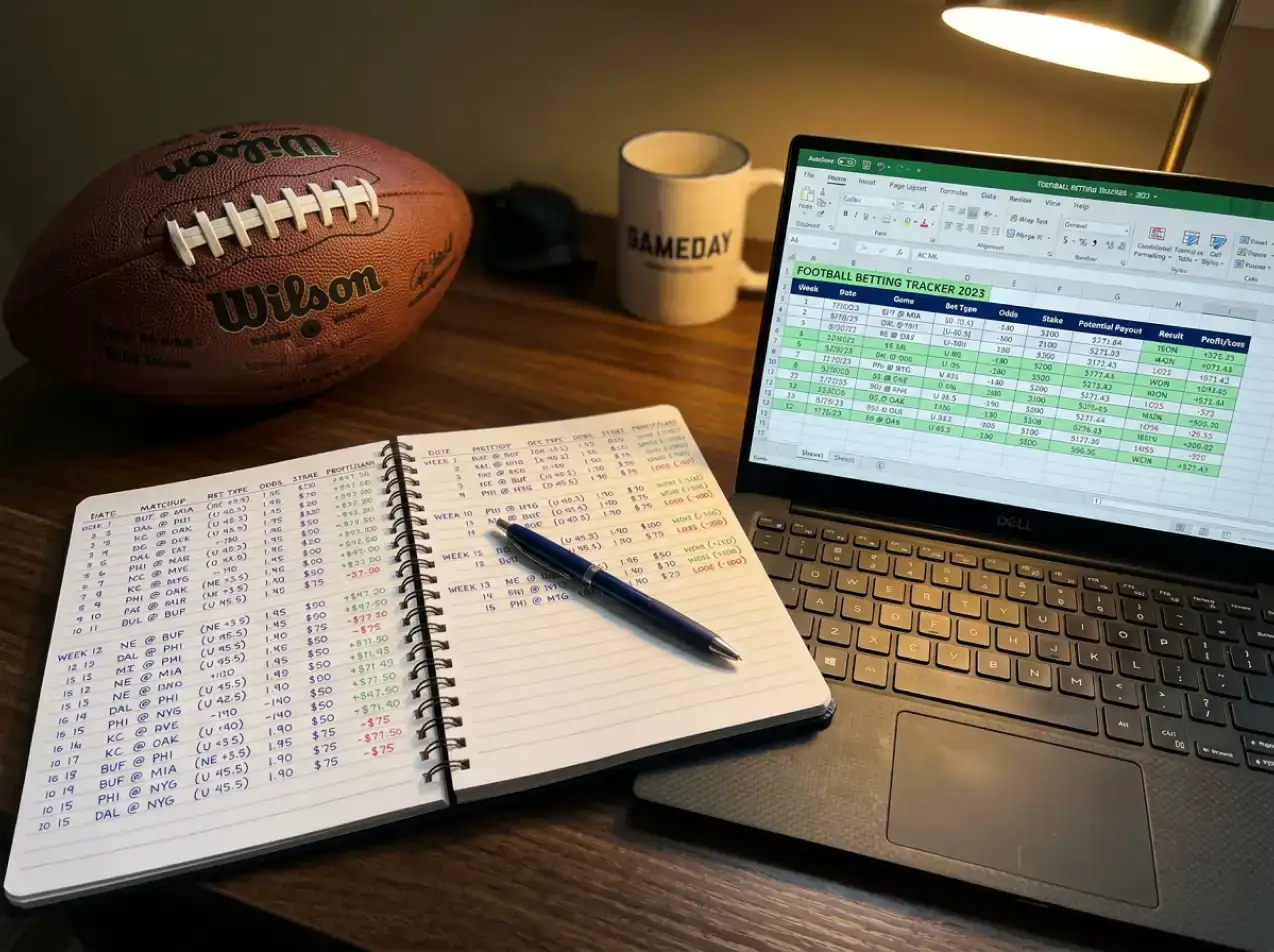
I lost money in my first three NFL betting seasons. Not because I didn’t know the sport — I’d been watching since the mid-2000s — but because I had no system. I picked games based on gut feeling, bet whatever amount felt right at the time, and used whichever bookmaker’s app happened to be open on my phone. Three years of that approach left me with a negative return and a detailed spreadsheet of exactly where I’d gone wrong.
Season four was different. I introduced a fixed unit system, opened accounts at five UK bookmakers to compare prices, and started tracking one number that transformed everything: closing line value. My win rate didn’t change dramatically — I went from roughly 48% to 53% on spreads — but my return swung from negative to positive because the structural changes in how I bet amplified the small analytical edge I’d developed. The NFL attracted $30 billion in legal wagers during the 2025 season. Most of that money was lost by people doing what I did in years one through three: picking smart, betting dumb.
This isn’t a collection of tips. It’s a system — the specific methods I use week in, week out, backed by the data that justifies each one. Every strategy here applies specifically to the UK market, where the bookmaker landscape, odds formats, and available tools differ meaningfully from the American environment where most NFL betting content originates.
To refine your approach further, incorporating NFL advanced metrics for betting like EPA and DVOA can give you a significant edge over the bookmakers.
NFL Bankroll Management: 2-5% Unit Staking Rules
The UK has approximately 340,000 adults who meet clinical criteria for problem gambling, with another 1.8 million classified as at-risk. I mention this not as a scare tactic but as a structural reality that shapes how any serious bettor should think about their bankroll. If you don’t have a system for managing your money, you’re not a strategist — you’re a participant in a system that’s statistically designed to beat you.
A bankroll is the total amount of money you’ve set aside exclusively for betting. Not your rent money, not your holiday fund — a dedicated pot that you can afford to lose entirely without any impact on your life. I’ve seen too many people skip this step, betting from their current account and telling themselves they’ll “track it mentally.” They won’t. Nobody does. The first step is to define a number, transfer it into a separate account or e-wallet, and treat it as your operating capital.
The unit system sits on top of that bankroll. One unit equals a fixed percentage of your total bankroll, typically between 2% and 5%. If your bankroll is 500 pounds and you set your unit size at 2%, each unit is 10 pounds. That’s what you stake on every standard bet. Not 10 on one game and 50 on the next because you’re “more confident” — 10 on every game unless you have a formally defined exception for high-conviction plays (and even then, I’d cap it at 3 units maximum).
Why this range? At 2%, you can endure a losing streak of 25 consecutive bets and still have more than half your bankroll intact. At 5%, a ten-bet losing streak cuts your bankroll in half. NFL spreads hit at roughly 50%, which means runs of five, six, or seven consecutive losses are not unusual — they’re expected over an eighteen-week season. The 2-5% rule isn’t conservative for the sake of being cautious. It’s mathematically appropriate for the variance profile of NFL betting.
I use flat staking, meaning every bet is the same unit size regardless of confidence level. The alternative — proportional staking, where you risk more on bets you feel stronger about — sounds logical but introduces a problem: it requires your confidence calibration to be accurate. If you’re consistently overconfident on your “strong plays” (and most people are), proportional staking amplifies your mistakes rather than your edge. Flat staking removes that variable. Every bet gets the same treatment, and your results over time reflect the quality of your analysis rather than the accuracy of your self-assessed confidence.
Here’s a worked example with a 500 pound bankroll at 2% per unit. Week 1: three bets at 10 pounds each. Two win at 10/11, one loses. Profit: 2 x 9.09 – 10 = 8.18. Bankroll: 508.18. Week 2: three bets at 10 pounds each (I don’t adjust unit size weekly — I recalculate monthly or after a 20% bankroll change). One wins, two lose. Loss: 9.09 – 20 = -10.91. Bankroll: 497.27. After two weeks and six bets, my bankroll has barely moved despite a 50% hit rate. That stability is the entire point. It lets me survive the inevitable downswings and stay in the game long enough for my edge to compound.
The Kelly Criterion — a formula that calculates optimal bet size based on your estimated edge — is popular in academic discussions. I don’t use it for NFL betting because it requires you to know your exact edge on every bet, which nobody does. Full Kelly also produces enormous swings that most recreational bettors can’t stomach. If you’re curious, fractional Kelly (one-quarter or one-half of the Kelly-recommended stake) is a safer variant, but I still find flat staking simpler, more robust, and better suited to a sport where the true edge is always uncertain.
One practical tool I’ve built into my routine: a monthly bankroll review. At the start of each month during the NFL season, I check my bankroll, recalculate my unit size if the bankroll has moved by 20% or more in either direction, and review my bet-by-bet log for patterns. Am I losing more on primetime games? Am I overperforming on totals and underperforming on spreads? Those patterns don’t always mean something — variance is real — but over three or four months, genuine skill gaps start to emerge from the noise. The discipline of regular review prevents the slow drift that turns a structured approach into an ad hoc one.
Finally, set a stop-loss threshold for any single week. I use 10 units. If I lose 10 units in a single NFL week — which would require a truly catastrophic run of results at 2% per bet — I stop betting until the following week. The purpose isn’t superstition; it’s recognising that if everything is going wrong simultaneously, there may be a systematic error in my analysis that week (perhaps I’ve missed a significant weather pattern, or my injury data is outdated), and the best move is to step back and reassess rather than chase losses in the Monday night game.
Line Shopping Across UK Bookmakers
Last October, I tracked every NFL spread bet I placed across a four-week stretch and recorded the best available price at each of my five UK bookmaker accounts versus the price I actually took. The result: on 14 out of 16 bets, at least one bookmaker offered a better number than the others. The average improvement was 0.3 points on the spread or roughly 2-3% in implied probability terms. That sounds small until you compound it over a season. At 200 bets per year, consistently getting 2-3% better prices is the equivalent of turning a breakeven record into a 5-6% ROI. No analysis improvement required — just checking five apps instead of one.
The process takes two minutes on your phone — and with most UK betting happening online, there’s no excuse not to do it. Bill Miller, head of the American Gaming Association, has spoken about how record revenues in regulated markets “demonstrate the broad appeal of regulated gaming markets and why strong state oversight remains essential.” The same principle applies in the UK — a well-regulated market with multiple licensed operators competing for your business creates the exact conditions where line shopping produces tangible value.
The mechanics are straightforward. Open three to five bookmaker apps, navigate to the NFL spread market for the game you want to bet, and compare the numbers. You’re looking at two things: the spread itself (is one site offering -2.5 while others have -3?) and the odds on the same spread (is one site offering 10/11 while another has evens?). Either difference improves your expected return.
Half a point on the spread matters enormously when key numbers are involved. If three bookmakers post -3.5 and one posts -3, that single site has just given you the most common margin of victory in NFL history as a push rather than a loss. I wrote extensively about why 3 and 7 dominate NFL margins in the key numbers guide — the short version is that field goals and converted touchdowns create natural clustering around those figures, so crossing them with a better number isn’t a marginal gain. It’s a structural one.
Some practical tips I’ve developed over the years. First, don’t shop after you’ve decided your bet — shop as part of the decision process. I open all five apps simultaneously and compare lines before I’ve committed to a position. Sometimes the price at one bookmaker is so much better than the others that it changes which side I bet on entirely. Second, pay attention to which bookmakers consistently post the sharpest NFL lines. The ones that move their numbers first are typically the ones with the most sophisticated pricing models. Those are the sites where the early lines represent the smartest estimate, and where deviations at other sites are most likely to represent value. Third, don’t neglect the exchanges. Betting exchanges operate on a different model — other punters set the prices, and the exchange takes a commission rather than building in an overround. For popular NFL markets, exchange prices often beat fixed-odds bookmakers, especially close to kick-off when liquidity is highest.
The discipline of line shopping is boring. There’s no clever analysis, no model-building, no thrill. It’s just comparing prices and taking the best one. But pound for pound, it’s the single highest-returning habit any UK NFL bettor can develop.
There’s one more dimension I want to mention: market depth. Not all UK bookmakers offer the same range of NFL markets. Some have full alternate spread menus with fifteen different numbers; others only post the main line. Some offer first-half and second-half spreads; others don’t. When line shopping, you’re not only comparing prices on the same market — you’re also discovering which bookmaker gives you access to the specific bet type that matches your analysis. If your model says the game will be close in the first half but separate in the second, you need a bookmaker that offers half-specific spreads. Access to the right market is as important as getting the best price on it.
For a complete overview of the market, always refer to our premier American football betting guide before finalizing your wagers.
Why Advanced Metrics Matter: A Quick Overview
For the first five years I bet on the NFL, I evaluated teams the way a casual fan does: wins and losses, points scored, the eye test. It worked well enough to keep me close to breakeven, but the breakeven barrier is where most punters stall. The US sports betting industry generated $16.96 billion in revenue during 2025 — revenue that comes directly from the pockets of bettors who can’t get past that barrier. Advanced metrics are what pushed me through it.
Two metrics transformed my analysis more than any others: EPA and DVOA. EPA — Expected Points Added — measures the value of every single play in terms of how many points it’s expected to contribute. A five-yard run on third-and-three is far more valuable than a five-yard run on third-and-fifteen, and EPA captures that context. Traditional stats treat both plays as “five rushing yards.” EPA treats the first as a significant positive and the second as functionally worthless. That distinction matters enormously when you’re trying to assess offensive and defensive quality beyond surface-level numbers.
DVOA — Defense-adjusted Value Over Average — takes a similar approach but benchmarks every play against the league average and adjusts for the quality of the opponent. A defence that looks dominant against a bottom-tier offence gets less credit than one that performs well against a top-five unit. DVOA gives you a composite number for every team’s offence, defence, and special teams, adjusted for strength of schedule, that you can compare directly across the league.
Both metrics are available for free. NFL play-by-play data is accessible through nflfastR (an R package) and rbsdm.com (a web interface). DVOA is published weekly by Football Outsiders. You don’t need a data science degree to use them — you need the patience to check the numbers before placing a bet and the willingness to let them override your instincts when they disagree.
The advanced metrics guide walks through each metric in detail with step-by-step examples of how to apply them to specific spread and totals bets. If you’re serious about moving beyond the breakeven barrier, that’s the next read. What I’ll say here is that the key insight isn’t any single metric — it’s the principle of using situation-adjusted data rather than raw totals. Raw stats lie in football more than in almost any other sport because game context (down, distance, score, time remaining) varies so wildly from play to play. Any metric that accounts for that context will outperform one that doesn’t.
Seasonal Betting Patterns: When Edges Appear
Not all weeks of the NFL season are created equal from a betting perspective, and recognising when edges tend to appear is a strategy in itself. Live in-play betting now accounts for 53.4% of all wagering activity globally — for the first time exceeding pre-match betting in 2026 — but the pre-match spread market still offers the most consistent structural patterns across the season.
Weeks 1 through 3 are my favourite stretch of the entire year. The market is pricing teams based on offseason narratives, preseason performance (which is almost meaningless), and last season’s results. But rosters have turned over. Coaching staffs have changed schemes. Depth charts have reshuffled. The gap between the market’s perception and on-field reality is at its widest in September, and that gap is where value lives. I’ve tracked my season-long results by month for the past eight years, and September consistently produces my highest ROI. The public is still calibrating, bookmakers are working with incomplete data, and sharp bettors are pouncing on the mispricings.
The bye week effect is another seasonal pattern worth tracking. NFL teams get one week off during the regular season — no game, no travel, extra preparation time. Teams coming off a bye have historically performed well against the spread, particularly when their opponent played a physical game the previous week. The reason is straightforward: rest, preparation time, and health. A coaching staff with two weeks to game-plan has an inherent advantage over one working on the standard short week. I don’t bet bye-week teams blindly, but I do add a small adjustment in their favour when my analysis is otherwise borderline.
Weather games offer a different kind of edge. When wind exceeds 20mph or temperatures drop below minus-five Celsius, passing offences struggle. That suppresses scoring, which means totals markets tend to overcorrect — or undercorrect — depending on whether the forecasted conditions are already priced in. I check weather forecasts for outdoor stadiums every Friday. If a significant weather event is developing but hasn’t been widely reported yet, the under on the total often holds value that disappears by Sunday morning once the broader market adjusts.
Late-season dynamics — Weeks 15 through 18 — present a different challenge entirely. Some teams have locked up playoff positions and rest starters. Others are eliminated and play loose, no-pressure football. And a handful are fighting for their postseason lives with maximum intensity. The motivation gap between teams creates pricing distortions, but you need to research each team’s specific situation. A team resting its starting quarterback in Week 17 isn’t going to cover a -7 spread, no matter how good their first-string numbers look. I track playoff scenarios religiously from Week 14 onwards, not because I enjoy the maths (I do, but that’s beside the point), but because the market is slow to price in strategic rest and motivation differentials. By the time the lineup news confirms that starters are sitting, the line has usually moved — but often not far enough.
The postseason itself follows different rules. I’ve covered playoff-specific strategy in a separate article, but the core principle is this: sample sizes shrink, coaching matchups matter more than regular-season records, and historical trends (like underdogs covering at a higher rate in the divisional round) deserve more weight than they’d receive during the regular season.
For UK punters specifically, aligning your betting routine with the broadcast schedule amplifies these seasonal patterns. The Sunday early window (6pm GMT) features the most games and the most pricing inefficiency because bookmakers are managing thirteen simultaneous events. The Sunday late window and primetime slots have tighter lines because the market’s full attention is on fewer games. If you’re watching on Sky Sports or Game Pass in the evening, save your live betting energy for the late window where your ability to process what’s happening on screen can outpace the automated odds adjusters. The early window is better suited to pre-match spread bets placed during the week.
NFL Strategy FAQ
How many units should a beginner risk per NFL bet?
Start at 1-2% of your bankroll per bet. If your bankroll is 300 pounds, that means 3 to 6 pounds per wager. This feels small, but it’s deliberately conservative — it protects you during the learning phase when your hit rate is still developing. Once you have a tracked record of at least 100 bets showing a positive ROI, you can consider moving to 3% per unit.
What NFL stats matter most for predicting game outcomes?
Situation-adjusted metrics outperform raw stats significantly. EPA (Expected Points Added) measures the value of every play in context, and DVOA (Defense-adjusted Value Over Average) benchmarks performance against opponents. Both are available for free and are more predictive of future results than traditional statistics like total yards or points per game.
Is flat betting or proportional staking better for NFL?
Flat betting — risking the same unit size on every wager — is more robust for most punters. Proportional staking (varying bet size by confidence) requires accurate confidence calibration, which most people overestimate. Flat staking removes that variable and ensures your long-term results reflect the quality of your picks rather than the accuracy of your self-assessed conviction levels.
Prepared by the American Football bet editorial staff.